
Presbyopia is the normal, age-related loss of the eye's ability to focus on close objects. It usually starts around age 40 and affects nearly everyone, which is why people in their 40s and 50s start holding menus at arm's length or reaching for reading glasses. It is not a disease, and it is easy to correct.
Presbyopia definition
The word comes from Greek and means "old eye". In presbyopia, the natural lens inside your eye becomes stiffer and less flexible over time, so it can no longer change shape easily to focus on things up close. The result is blurry near vision, while your distance vision may stay the same.
What causes presbyopia?
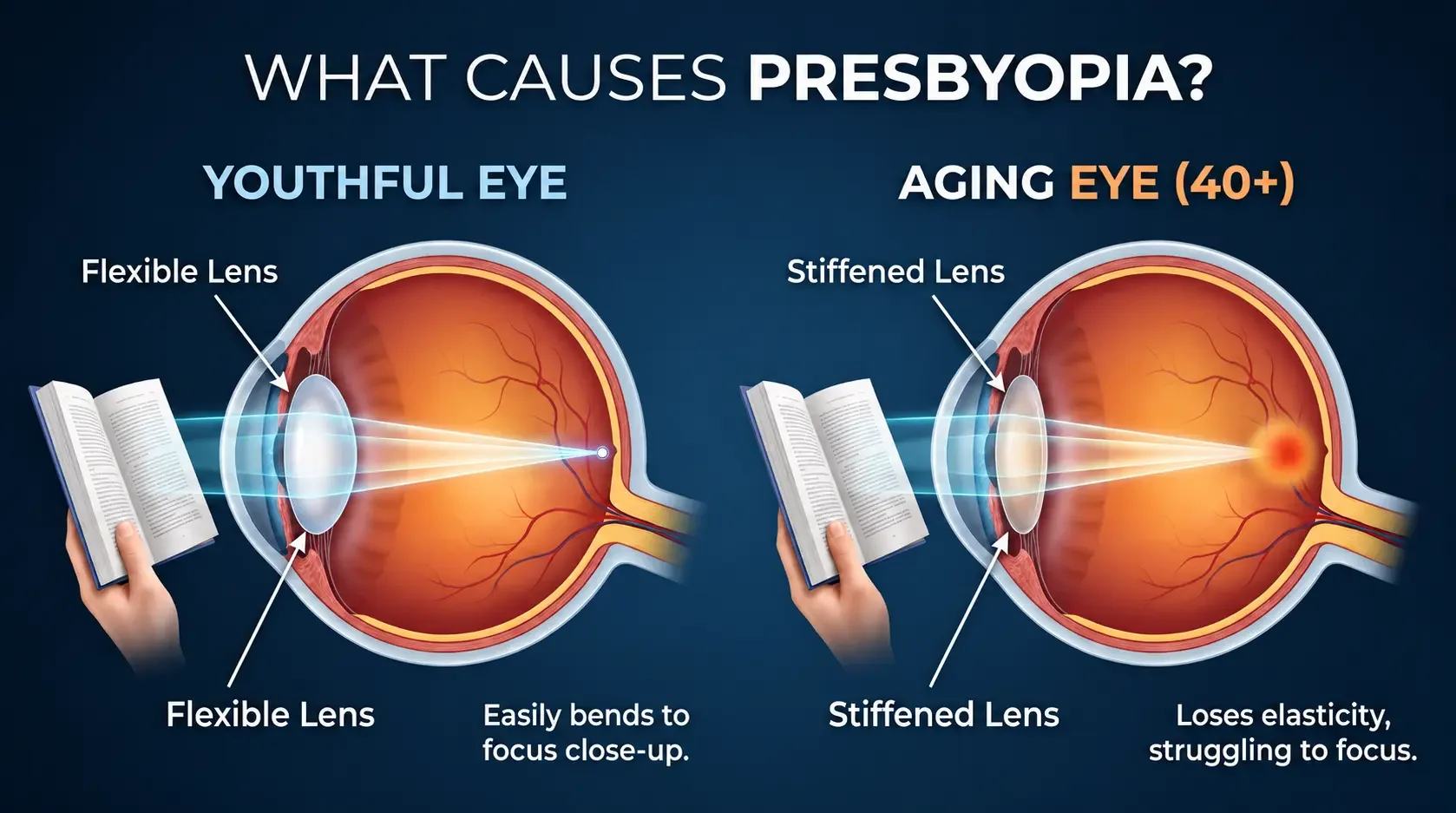
Inside your eye, a clear lens sits behind the pupil. When you look at something close, small muscles around the lens tighten and the lens becomes rounder, which focuses the image on your retina. This is called accommodation.
With age, the lens hardens and the muscles can't reshape it as well. Nothing you did caused it, and it can't be prevented. It is simply part of aging, like gray hair.
At what age does presbyopia start?
Most people first notice presbyopia in their early to mid-40s. It tends to get slowly worse until your mid-60s, so you may need a stronger reading prescription every few years during that time.
Presbyopia symptoms
Common signs include:
Holding books, menus or your phone farther away to read them
Blurry vision at your normal reading distance
Eye strain, tired eyes or headaches after reading or close work
Needing brighter light to read
Trouble switching focus between near and far
Squinting to see small print
Symptoms are often worse when you are tired or in dim light.
How is presbyopia diagnosed?
A comprehensive eye exam will find it. Your eye doctor will check your distance and near vision, test how well your eyes focus, and examine the health of your eyes. This matters because other eye conditions can also blur near vision, and regular exams catch eye diseases such as glaucoma and cataracts early.
Presbyopia treatment options
There is no cure that stops the lens from aging, but there are many ways to see clearly again:
Reading glasses. Simple lenses for close work. Over-the-counter readers can help in a pinch, but they are the same strength in both eyes and don't correct astigmatism.
Bifocals. Lenses with two zones, distance on top and reading on the bottom.
Progressive lenses. Lenses that blend distance, middle and near vision smoothly with no visible line. Read more in our guide to types of eyeglass lenses.
Multifocal contact lenses. Contacts with several zones for near and far, for people who prefer not to wear glasses. See our contact lens services.
Monovision contact lenses. One eye is corrected for distance and the other for near. It works for some people and not for others.
Prescription eye drops. An FDA-approved eye drop can temporarily improve near vision for some people with presbyopia. Ask your eye doctor whether it's right for you.
Surgical options. Some surgical procedures can reduce the need for reading glasses, and we can refer you to a surgeon if that interests you.
The best choice depends on your prescription, your work, your hobbies and your preferences. Learn how glasses work, or see our eyeglasses and frames in Staten Island.
Presbyopia vs. farsightedness
They are often confused because both affect near vision.
| Comparison | Presbyopia | Farsightedness (Hyperopia) |
|---|---|---|
| Cause | The eye's lens loses flexibility with age | The eye's shape causes light to focus behind the retina |
| When it starts | Usually in the 40s | Can occur at any age, even in childhood |
| Affects | Near vision | Near vision, and sometimes distance vision |
| Can you have both? | Yes | Yes |
Can you prevent presbyopia?
No. It happens to nearly everyone. You can protect your overall eye health by getting regular eye exams, wearing UV-blocking sunglasses, not smoking and eating well. See our guide to foods good for your eyes. Eye exercises and supplements won't stop presbyopia.
Having trouble seeing up close?
If small print is getting harder to read, a comprehensive eye exam can find out why and show you your options. Focus Vision Care in Staten Island offers eye exams, eyeglasses, progressive lenses and contact lens fittings at 2260 Victory Blvd, Staten Island, NY 10314.
Contact Us | Call (718) 448-1622 | Walk-ins welcome
Frequently Asked Questions
-
It is the normal, age-related loss of the eye's ability to focus on near objects, usually beginning around age 40.
-
Holding things farther away to read, blurry near vision, and eye strain or headaches after close work.
-
No, but it is easily corrected with glasses, contact lenses and, for some people, other treatments.
-
Yes. It usually progresses until your mid-60s, so your reading prescription may need updating.
-
No. Your eyes change because of aging, not because you wear reading glasses.
-
Over-the-counter readers can work if your eyes are about the same and you have no other vision problems. An eye exam makes sure you get the right strength and checks your eye health.
-
No. Presbyopia is caused by aging of the eye's lens, while farsightedness is caused by the shape of the eye. You can have both.
-
Yes. Multifocal and, for some people, monovision contacts can correct presbyopia. Ask us at a contact lens exam.