
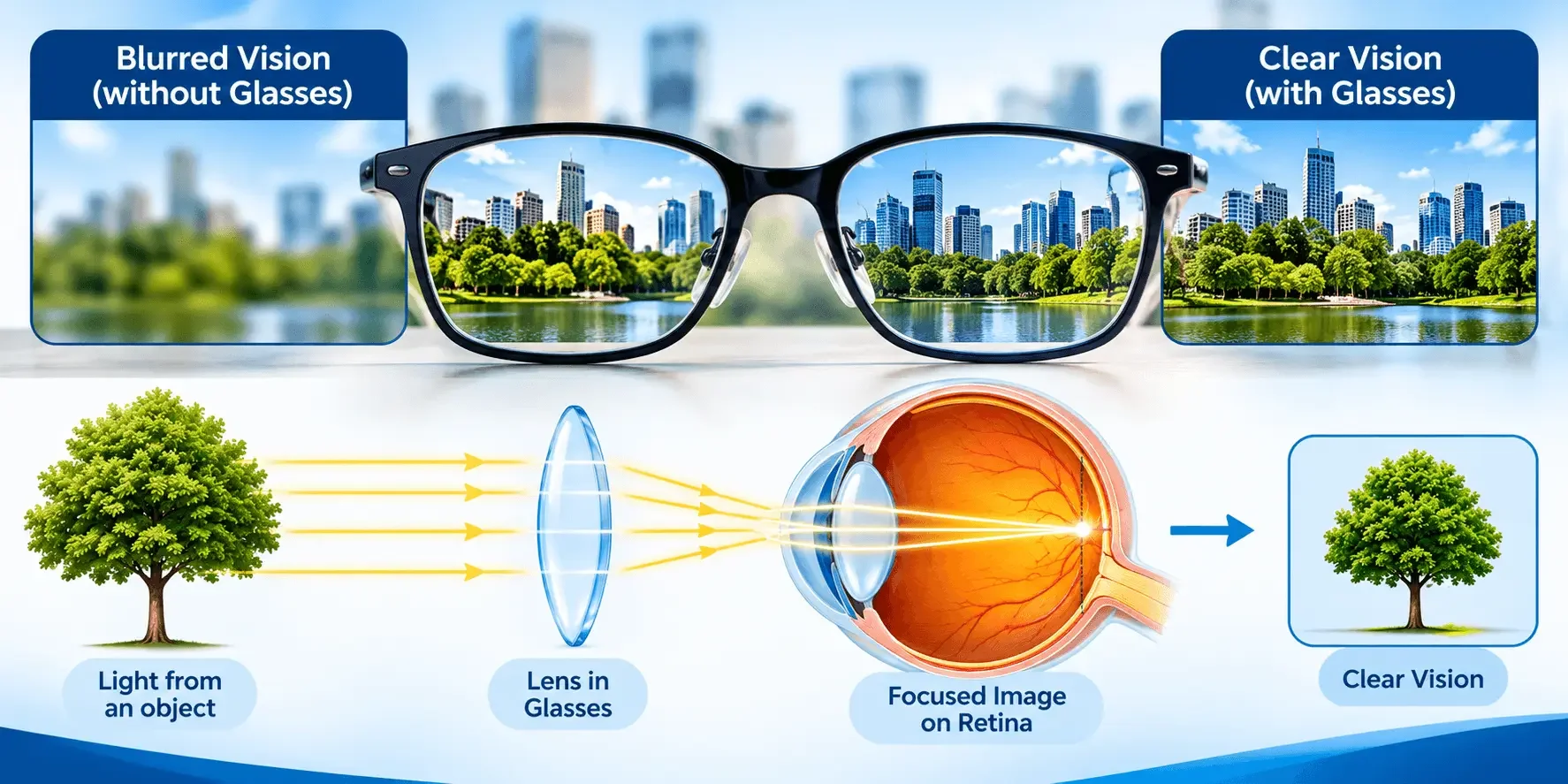
Glasses work by using lenses to refract light to ensure it lands directly on your retina. If your eye cannot refract light on its own, the additional refraction caused by lenses in your glasses will focus the light to create a clear image.
How your eye focuses light?
Light reflects off objects and enters your eye. Your eye has two structures that refract the light:
Cornea – This is the clear dome at the front of your eye and does most of the focusing.
Lens – This is a clear structure inside your eye. The shape of the lens changes to help focus light to see close up or further away.
The light then hits your retina. This converts the light into signals and sends them down the optic nerve to your brain. To create a clear image the light must hit directly on your retina. If it hits in front or behind your retina everything looks blurred. This is known as refractive error.
How glasses help with Short Sightedness?
Short sightedness, also known as myopia. This occurs when the eye is slightly longer or the cornea is too curved. The light will hit in front of your retina causing everything in the distance to be blurred. However, things that are up close will be clear.
Concave (minus) lenses are used. These are thinner in the centre. They will cause the light to diverge slightly before entering your eye. This will cause the light to focus directly on your retina.
How glasses help with Long Sightedness?
Long sightedness, also known as hyperopia. This occurs when the eye is slightly shorter or the eye doesn’t have enough focusing power. The light hits behind your retina. This can cause blurring or eye strain when doing close up tasks.
Convex (plus) lenses are used. These are thicker in the centre. They will cause the light to converge before reaching your eye. This brings the light into focus on your retina.
How glasses help with Astigmatism?
Astigmatism occurs when the front of your eye is slightly more oval like a football. This causes the light to hit multiple points causing everything to look blurred or distorted. The lens will have a cylinder component to give extra focusing power in one direction only.
How Reading Glasses Work?
At around the age of 40 the lens inside your eye becomes less flexible making it harder to focus on things up close. This is known as presbyopia and occurs in almost everyone.
Reading glasses use a plus lens to give extra focusing power for close up tasks. Over the counter readers can be useful but they are the same power in both eyes and won’t help with astigmatism. Getting a prescription after an eye exam will be more accurate.
How Bifocals and Progressives Work?
If you require help with distance and close up vision you can have lenses with multiple powers within:
Bifocals have two sections. One section is for distance at the top and one section for reading at the bottom. There is a noticeable line.
Progressives have multiple powers that smoothly transition from top to bottom. There is no line. The top section is for distance, the middle is for intermediate distances like a computer and the bottom is for reading.
Progressives can be a little tricky to get used to. You will have to move your head and eyes slightly to get into the correct section. However if they fit well they will make all the difference.
How to Read Your Glasses Prescription?
Your prescription contains numbers telling the laboratory how much refraction your eyes require.
Sphere (SPH) – This is the main power of your lens. Minus (-) means you are short sighted. Plus (+) means you are long sighted.
Cylinder (CYL) and Axis – This tells how much and what direction your astigmatism is corrected.
ADD – This gives extra power to see close up. Used in reading glasses, bifocals and progressives.
PD (Pupil Distance) – This tells how far apart your pupils are. Ensures the lenses are centred correctly.
OD/OS – Right eye/left eye.
How lens coatings and options work?
Anti Reflective – This reduces glare caused by reflections on the lens. This allows more light to reach your eye. This helps reduce glare from headlights and screens. It also makes your lenses appear clearer.
Photochromic (Light responsive) – These lenses darken in the sun. They will clear indoors. See our guide on Photochromics vs. Prescription Sunglasses.
High Index Lenses – These use high index materials that refract light more effectively. This means high prescriptions can be made thinner and lighter.
Blue Light Filtering – These lenses filter some blue light from screens. Research has not shown they stop eye strain on their own. See Blue Light Blocking: Do You Really Need It?
Will glasses make your eyes go weak?
No. Your glasses will not make your eyes go weak or make you rely on them. When you first start wearing glasses you might become aware how blurry things are. This is because you have become used to seeing clearly. Any changes to your vision will be due to changes in your eye. This is why it is important to have regular eye tests especially in children as their eyes are still developing.
When should I get my eyes tested?
If you are experiencing any blurriness, headaches, squinting, difficulty reading or eye strain. Or you haven’t had an eye test in over a year or two. Your glasses will only work properly if you have a correct prescription.
Book an Eye Exam | Call (718) 448-1622 | Walk-ins welcome
If your glasses are uncomfortable or slipping they could need adjusting. See our 4 signs your frames need adjusting and learn how to choose frames for your face shape.
Frequently Asked Questions
-
They bend light by a precise amount, chosen from your eye exam, so it focuses on your retina instead of in front of or behind it.
-
They combine several lens powers in one lens, from distance at the top to reading at the bottom, with a smooth blend and no visible line.
-
They add plus power so you can focus on near objects when your eye's own lens has become less flexible with age.
-
They correct the way light focuses inside your eye, so the image lands sharply on the retina.
-
Glasses correct refractive errors such as nearsightedness, farsightedness, astigmatism and presbyopia. They don't treat eye diseases like glaucoma or cataracts, which is why regular eye exams are important.
-
Yes. Your eyes change over time, so it's a good idea to have an eye exam every one to two years, or as your doctor recommends.
-
Focus Vision Care in Staten Island offers comprehensive eye exams, prescription eyeglasses and frames, and expert fittings, all in one office at 2260 Victory Blvd, Staten Island, NY 10314.