
UV-blocking contact lenses help shield part of your eye from harmful ultraviolet (UV) light, but they don't replace sunglasses. Not every contact lens blocks UV, so it's worth asking your eye doctor which of your options do. Here is what to know.
Why UV protection matters for your eyes?
You protect your skin from the sun, and your eyes need the same care. Over time, UV exposure is linked to:
Cataracts, a clouding of the eye's natural lens
Growths on the surface of the eye, such as pterygium
Sunburn of the eye's surface (photokeratitis), which can be painful after long exposure to bright sun, snow or water
Damage to the delicate skin around the eyes, including eyelid skin cancers
Possibly a higher risk of macular degeneration later in life
UV exposure builds up over the years, even on cloudy days, which is why protection matters long before problems appear.
How UV-blocking contact lenses work?
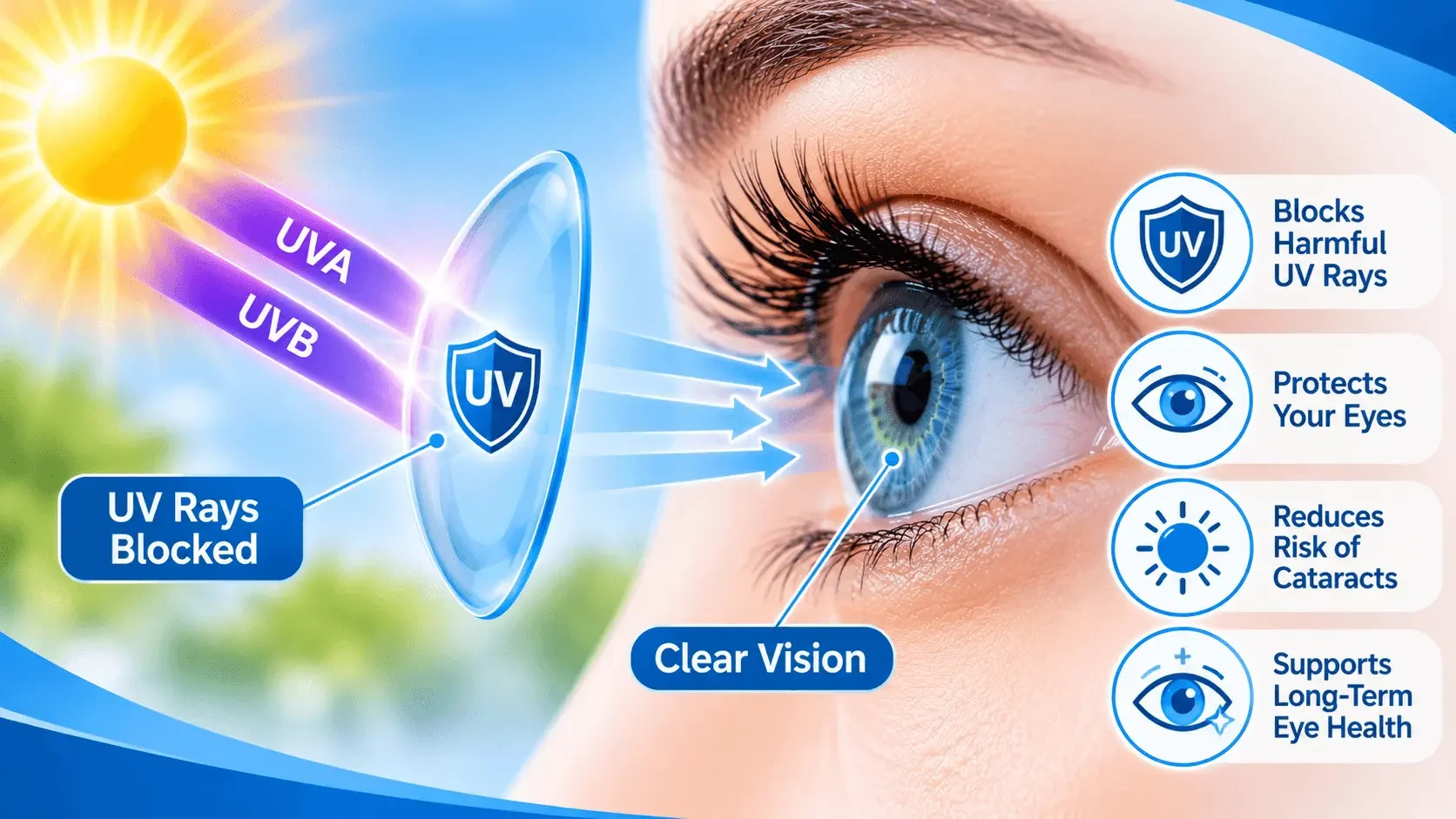
Some contact lenses are made with a UV-absorbing material built into the lens. It absorbs a portion of the UV light before it reaches the surface and inside of your eye.
The U.S. FDA recognizes two classes of UV-blocking contact lenses:
| Class | UVA Blocked | UVB Blocked |
|---|---|---|
| Class I | at least 90% | at least 99% |
| Class II | at least 70% | at least 95% |
The packaging of a UV-blocking lens usually says so. If it doesn't, ask your eye doctor.
What UV-blocking contacts don't protect?
A contact lens covers the cornea (the clear front of the eye) and a small part of the white of the eye, but not the whole eye. UV-blocking contacts do not protect:
The rest of the white of the eye
Your eyelids and the skin around your eyes
Your eyes from the sides, or from light reflected off water, snow or pavement
That is why eye care professionals recommend wearing UV-blocking contacts together with sunglasses and a wide-brimmed hat, not instead of them. See our guide to photochromic lenses vs. prescription sunglasses.
Who benefits most from UV-blocking contacts?
They are a good idea for almost any contact lens wearer, and especially for people who:
Spend a lot of time outdoors, such as runners, cyclists, gardeners, boaters and beachgoers
Drive often during the day
Play sports outdoors, or ski or snowboard
Are sensitive to bright light
Have a family history of cataracts or macular degeneration
Children and teens who wear contacts spend a lot of time outdoors too, so ask your eye doctor about UV protection for them as well.
How to Choose UV-Blocking Contact Lenses?
UV protection is only one part of choosing contacts. The right lens also depends on your prescription, the shape of your eye, how dry your eyes are, and how you use your lenses. That is why a proper contact lens exam and fitting matters.
At your exam, tell us how much time you spend outdoors, and we can help you choose a lens that fits your eyes and your lifestyle, including options with built-in UV protection.
Already have a prescription? You can order your contacts online with a valid prescription.
Ask Us About UV-Blocking Contacts
Focus Vision Care in Staten Island offers contact lens exams and fittings, including daily, multifocal and specialty lenses, at 2260 Victory Blvd, Staten Island, NY 10314. Ask us about UV-blocking options at your next visit.
Book a Contact Lens Exam | Call (718) 448-1622 | Walk-ins welcome
Learn more about our eye exams or our eye doctor in Staten Island.
Frequently Asked Questions
-
Some do. Contact lenses with a UV blocker built in absorb part of the UV light, but regular contacts without one don't. Check the packaging or ask your eye doctor.
-
Yes, they add a layer of protection, especially if you spend a lot of time outdoors. They are best used along with sunglasses, not instead of them.
-
No. Contacts don't cover your whole eye, your eyelids or the skin around your eyes. Sunglasses give broader protection and also cut glare.
-
Only if they contain a UV blocker. A clear lens by itself does not protect your eyes. Ask your doctor whether yours do.
-
No. The UV blocker is built into the lens material and does not change your vision or the look of your eyes.
-
At least once a year, or as your eye doctor recommends, so your lenses and your eye health stay in check.